
General ledger, fixed assets, payables (including matching, vouchering, and paying) , receivables and collections, cash management, and financial consolidation

Are you ready to automate your systems?
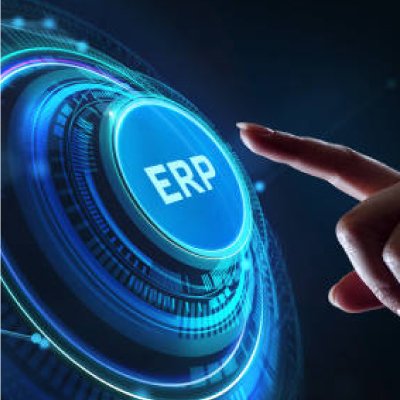
Enterprise Resource Planning (ERP) refers to a type of software used by companies to manage typical business processes such as accounting, purchasing, project management, risk management, and compliance, as well as supply chain tasks. Also, it supports automation and procedures in finance, human resources, manufacturing, supply chain, services, procurement, and other areas of the organization.
.jpg)
Importance of ERP

Enhanced Productivity

Better competitiveness in the market

More Effective Inventory Control
We believe in taking technologies to the next level
- Enhances Precision and Productivity by eliminating duplication and increasing productivity.
- ERP’s systematic procedure helps in increasing overall efficiency.
- Helps in improving the coordination within the team.
- Enhances customer satisfaction.
Functional Area

Accounting for Financial Transactions
Management Accounting
Budgeting, costing, cost management, and activity-based costing are all part of management accounting.


Human Resource
Recruitment, training, rostering, payroll, benefits, retirement, and pension plans, diversity management, retirement, and separation are all aspects of human resources.
Manufacturing Process
Engineering, work orders, scheduling, capacity, workflow management, quality control, manufacturing processes, manufacturing projects, manufacturing now, and product life cycle management are all aspects of the manufacturing process.

Order Processing Process
Order input, credit checks, pricing, availability to promise, inventory, shipping, sales analysis, reporting, and sales commissioning are all steps in the order processing process.
Supply Chain Management
Supply chain management includes an order to cash, purchasing, inventory management, scheduling suppliers, product configurators, claims to process, and warehousing (receiving, putaway, picking, and packing)
.png)
Enterprise Resource Planning services to streamline business processes.
Save time and costs with a systematic automated system for your management accounting, human resources, manufacturing process, and supply chain management.
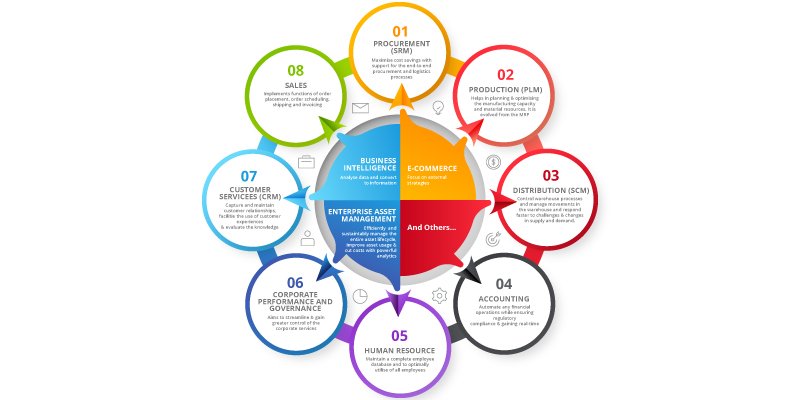
Areas where ERP can help to automate business insights
Our Approach

Financials
We provide a clear picture of your overall financial health through our worldwide financial platform that links and automates your financial management operations, including payables, receivables, fixed assets, spending, and reporting.

Procurement
Our Procurement is an integrated source-to-settle suite that helps in lowering risk, increasing savings, and boosting profitability by automating business processes and providing high-end security to the business.
Project Management
By assigning the appropriate individuals to the appropriate projects, you can maintain employee engagement, support organizational goals with a clear understanding of financial performance throughout your project portfolio, and quickly adjust to changing client demands to keep them satisfied.

Risk Management and Compliance
Our Risk Management and Compliance is a security and audit solution that manages user access to the financial data in your ERP system keeps track of user activities, and automates the process of complying with legal requirements.

Enterprise Performance Management
With our EPM you can easily plan across finance, HR, supply chain, and sales, which also speeds up the financial close procedure and helps you make smarter decisions.
Supply Chain Management (SCM)
With our Supply Chain Management & Manufacturing, businesses can respond quickly to changing business conditions in terms of demand, supply, and manufacturing.
FAQ ?
Yes, we can convert existing data to a new ERP system. We can make the migration of large volumes of data a simple process, With the help of our experienced working professionals.
Every company has specific operational requirements. Fortunately, ERP software can be altered to t the demands of the company and remove functions and features that are unnecessary. The software can be further linked with additional systems to fulfill the organization's ongoing demands as the rm expand.
ERP is a type of software application used most often by medium and larger enterprises, and sometimes by smaller companies. ERP software focuses on integrating business processes into a single, streamlined database and user interface by offering modules for each of the core business areas: human resources, financials, inventory management, sales, and customer relationship management, along with other business-critical functionalities.
A successful ERP implementation is the difference between an ERP that functions and an ERP that provides outstanding investment return by supporting specific business objectives. ERP software selection is separate from the implementation process, but choosing an ERP that meets your business's needs dramatically increase the odds of a successful ERP implementation.
Some companies may not have an IT department capable of handling complex software implementation projects. In these cases, the ERP vendor or another service provider, such as a value-added reseller, will dictate the implementation methodology.
Enterprise Resource Planning services to streamline business processes.
Save time and costs with a systematic automated system for your management accounting, human resources, manufacturing process, and supply chain management.